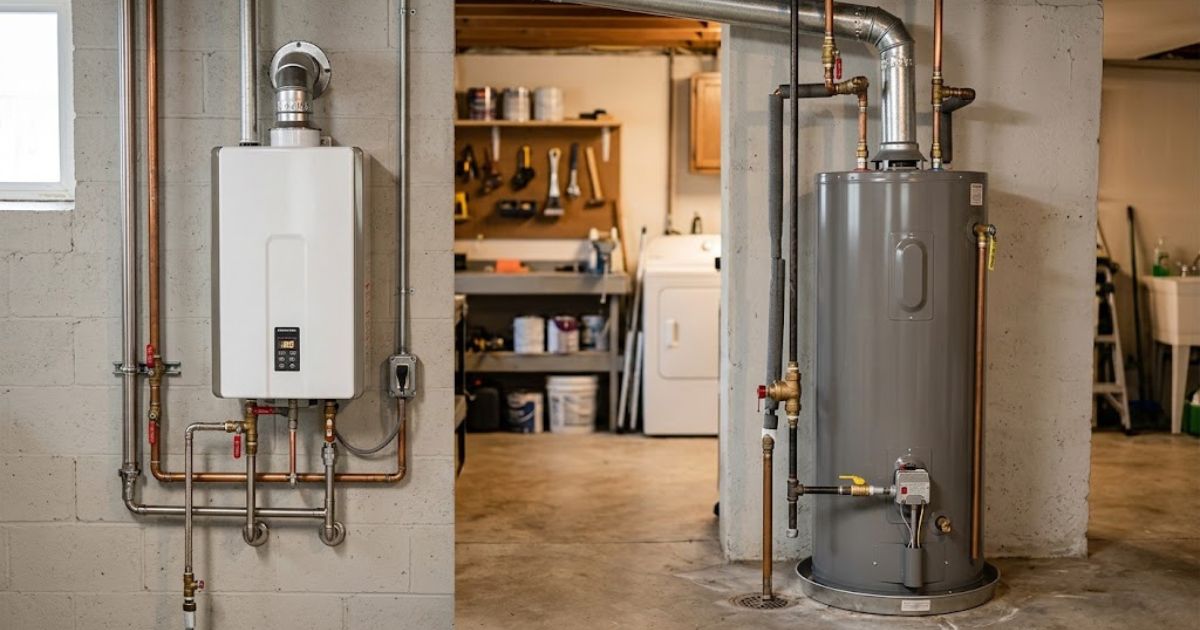
Every homeowner replacing a water heater eventually hits the same question: stick with a traditional tank, or switch to tankless? Both are legitimate, well-proven options, and the right choice depends on real factors specific to your household and, in Colorado's case, some genuine regional considerations that generic national advice often skips.
What "On Demand" Actually Feels Like Day To Day
In practice, a correctly sized tankless system feels like an endless hot shower with no warning that it's about to run cold, which is the main appeal for larger households. There's a very slight delay compared to a tank system before hot water reaches the tap, since the unit needs a moment to detect flow and begin heating. This delay is measured in seconds and isn't noticeable to most users after the first few uses.
How Each Type Actually Works
A traditional tank water heater stores and continuously heats a set volume of water, ready to use whenever you turn on a hot tap. A tankless unit, by contrast, heats water on demand as it flows through the unit, with no storage tank at all. This fundamental difference drives most of the practical distinctions homeowners actually care about.
The Altitude Factor Colorado Homeowners Should Know About
Gas-fired appliances, tankless units included, are affected by elevation, since lower atmospheric pressure at altitude changes combustion efficiency. Littleton sits at a meaningful elevation above sea level, and gas tankless units installed here need to be properly sized and, in some cases, specifically rated for high-altitude installation to perform as expected. This isn't a reason to avoid tankless, but it is a reason to make sure whoever installs yours accounts for it rather than treating a Denver-metro installation identically to a sea-level one.
Weighing Tankless Vs. Traditional?
We'll size the right option for your home and altitude.
Hot Water Supply: The Real Practical Difference
A traditional tank has a finite hot water supply. Once it's used up, you wait for it to reheat, which is the classic "someone else used all the hot water" problem in larger households. Tankless units provide continuous hot water as long as the flow rate demand doesn't exceed the unit's capacity, but that capacity is a real limit. A tankless unit sized for one bathroom running simultaneously with a shower and a dishwasher can be overwhelmed if it wasn't sized for that combined demand from the start.
Hard Water's Effect On Both Types
Front Range hard water affects both tank and tankless systems, but the specific vulnerability differs. Tank systems accumulate sediment on the tank floor, gradually reducing capacity and efficiency. Tankless units are vulnerable to scale buildup on the heat exchanger, which can reduce efficiency and, over time, damage the unit if the water isn't treated. Tankless manufacturers commonly recommend a whole-home water softener specifically to protect the unit's heat exchanger in hard water regions like this one.
Electric Vs. Gas Tankless: A Separate Consideration
Electric tankless units exist and avoid the altitude and venting considerations gas units face. They typically require substantial electrical service upgrades to support the load, and whole-home electric tankless capacity for a colder climate like Colorado's is genuinely more limited than gas options. Most whole-home tankless installations in this region are gas-fired for that reason, with electric tankless more commonly used for a single remote fixture rather than an entire house.
Upfront Cost Vs. Long-Term Cost
Tankless units cost more to purchase and install than a comparable traditional tank, often significantly more when a gas line upgrade or venting change is needed to support the tankless unit's requirements. Traditional tanks are cheaper upfront and simpler to install as a straightforward swap. Over a tankless unit's longer typical service life, and with genuine energy savings from not continuously heating stored water, the cost gap narrows, but it rarely disappears immediately, and homeowners should go in expecting a real upfront cost difference.
Space And Lifespan Considerations
Tankless units are wall-mounted and take up a fraction of the floor space a tank requires, which matters in smaller utility closets or when reclaiming storage space is a genuine priority. According to standard manufacturer lifespan ratings, tankless units also typically outlast traditional tanks by a meaningful margin, often reaching 15 to 20 years of service compared to a tank's more common 10 to 12 year lifespan, assuming appropriate water treatment and maintenance in either case.
What A Correct Sizing Assessment Actually Looks At
A proper tankless sizing calculation accounts for your household's peak simultaneous hot water demand and your home's specific altitude. It also factors in the incoming groundwater temperature, which is colder here than in warmer climates and requires more temperature rise to reach usable hot water. Skipping any of these factors is how homeowners end up with an undersized unit that technically works but disappoints during genuinely high-demand moments, like multiple showers running during a busy morning.
A Quick Comparison
Traditional Tank Fits When
- Upfront cost is the primary concern.
- A straightforward swap is preferred.
- Household hot water demand is moderate.
- Existing gas line and venting already fit.
Tankless Fits When
- Continuous hot water matters for a larger household.
- Floor space in the utility area is limited.
- Long-term energy savings are a priority.
- You're willing to pair it with a softener.
Common Questions
Do I need a bigger gas line for a tankless unit?
Often yes, since tankless units typically require higher gas flow than a comparable tank unit. This is assessed during installation and factored into the overall cost.
Is tankless actually worth it in a smaller Colorado home?
It can be, mainly for the space savings and longer lifespan, even if the hot water demand doesn't strictly require it. The altitude and hard water factors apply regardless of household size.
Can I convert my existing tank setup to tankless?
Yes, though it usually involves gas line, venting, and electrical adjustments beyond a simple swap, which is why professional assessment matters before committing to the conversion.
Do tankless units need regular maintenance?
Yes, periodic descaling to remove hard water mineral buildup on the heat exchanger is recommended, generally on an annual basis in hard water regions like the Front Range.
Does a tankless unit work during a power outage?
Gas tankless units typically require electricity for their electronic ignition and controls, so most won't function during a power outage unless paired with a backup power source, similar to many modern gas furnaces.
If you're leaning toward a tankless upgrade, our tankless water heater service page covers sizing, altitude considerations, and installation in more depth. If a traditional tank still makes sense for your household, our water heater installation and replacement page covers that straightforward path. Chatfield Bluffs' newer condos and homes are a common setting for this exact decision, since many are being outfitted or upgraded for the first time rather than replacing decades-old existing units.