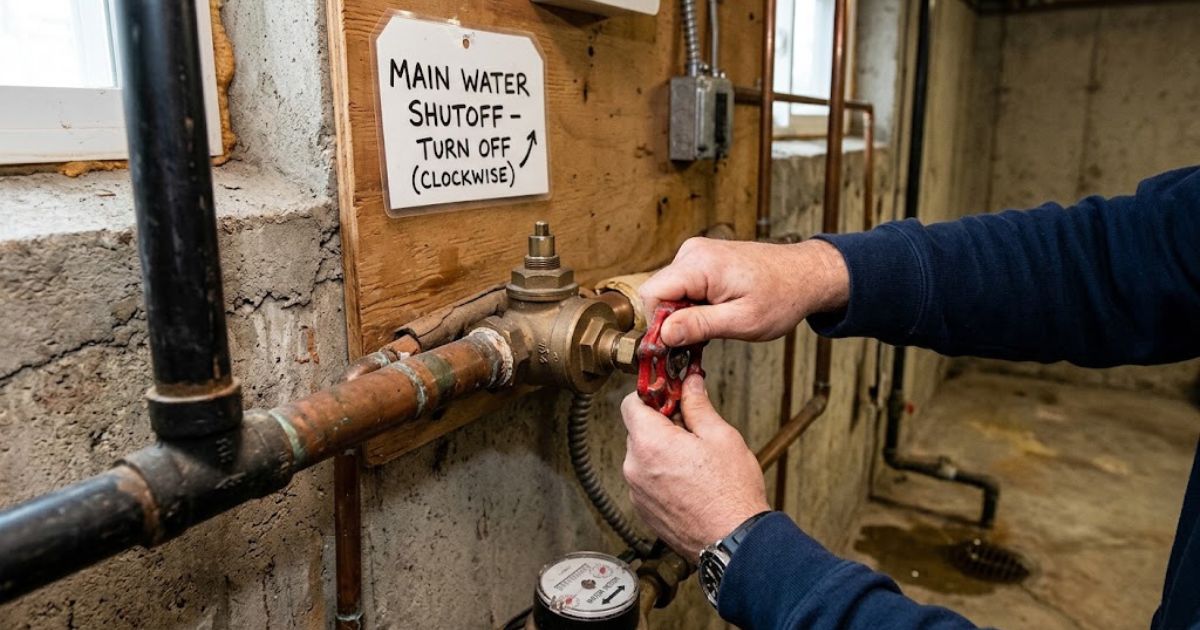
A burst pipe doesn't give you time to think it through calmly. Water is moving, the sound alone is stressful, and every minute matters for how much damage the house ends up with. Here's the order that actually matters, based on what limits damage fastest.
Why Order Matters More Than Speed Alone
It's tempting to rush toward whatever feels most urgent, often grabbing towels first because the water is visible and the damage feels immediate. But towels don't stop the flow, they only slow how fast it spreads. The main shutoff is what actually ends the emergency at its source, which is why it has to come before containment, not after it. A calm, correctly ordered response genuinely limits damage more than a frantic, unordered one.
Minute One: Find And Shut The Main Water Valve
Before anything else, get to your main shutoff valve. This is the single most impactful action in the entire emergency, since it stops new water from entering the system regardless of where the pipe actually failed. If you don't already know where yours is, common locations include near the water meter, in a basement, a crawlspace, or a utility closet close to where the main line enters the house. This is exactly why finding it before an emergency, not during one, matters so much.
Minutes Two And Three: Cut Power To The Affected Area
If water is anywhere near outlets, light fixtures, or any electrical panel, shut off power to that specific area at the breaker box. Only do this if you can reach the panel without walking through standing water. According to standard electrical safety guidelines, water and electricity together are a serious hazard, and this step should never be skipped if there's any question about proximity between the water and electrical components.
Pipe Actively Burst Right Now?
Call while you're shutting off water. We're already on our way.
What If The Burst Is In A Wall Or Ceiling?
A pipe bursting behind drywall doesn't give you the same visual confirmation as one in an open basement or crawlspace. Watch for a growing wet spot, bulging or sagging drywall, or water actively dripping from a ceiling. Even without seeing the pipe itself, the main shutoff response is identical. Cut the water supply first, then let a professional locate the specific failure point once they arrive, rather than cutting into drywall yourself to investigate.
Minutes Four Through Six: Call For Help While Containing What You Can
Call a plumber immediately, ideally while someone else is working on containment, since the two things happen faster in parallel than in sequence. If you can safely place towels, buckets, or a tarp to redirect water away from electronics, furniture, or flooring that would be expensive to replace, do that while you're on the phone. Don't delay the call to finish containing everything first. The plumber needs to be en route as early in the process as possible.
Minutes Seven And Eight: Move Valuables And Document What You See
Move anything easily portable and valuable away from the affected area, and take photos or a short video of the damage as it's happening, not after cleanup begins. This documentation matters significantly for insurance purposes, and it's much easier to capture accurately in the moment than to reconstruct later from memory.
Minutes Nine And Ten: Ventilate If It's Safe To Do So
If weather conditions allow, opening windows in the affected area helps with air circulation while you wait for help to arrive, which can modestly slow the pace of moisture absorption into surrounding materials. This is a minor step compared to the main shutoff and the call for help, but it's worth doing if it's genuinely easy and safe given the conditions outside.
What Happens After The First 10 Minutes
Once water is shut off and help is on the way, the priority shifts to extraction and drying. This needs to happen quickly given the real risk of mold developing in materials that stay wet for more than a day or two. This is a distinct phase from the pipe repair itself, and depending on how much water escaped before the shutoff, it may involve professional water mitigation equipment rather than just towels and a fan.
Why This Emergency Happens More In Certain Homes
Homes with original galvanized or aging copper supply lines, or those in areas prone to hard freezes affecting exposed plumbing, see burst pipes at a genuinely higher rate than newer construction with modern PEX piping. If your home fits that profile, having this response plan mentally rehearsed, and your main shutoff valve's location confirmed in advance, matters even more than it does for a newer, lower-risk home.
A Quick Reference For What Matters Most
Do Immediately
- Shut off the main water valve.
- Cut power to the affected area if safely reachable.
- Call a plumber right away.
Do While Waiting
- Contain water with towels or a tarp.
- Move valuables out of the affected area.
- Photograph the damage for insurance.
Common Questions
What if I can't find my main shutoff valve in time?
If you genuinely can't locate it, call for help immediately and focus on containment and moving valuables while you wait, since a technician can locate and operate it quickly once on-site.
Is it safe to walk through standing water to reach a breaker panel?
No, never walk through standing water to reach an electrical panel. If the panel isn't safely accessible, leave the power on and focus on water shutoff and containment instead.
How much water damage happens in just a few minutes?
This varies by pipe size and water pressure, but even a few minutes of an unaddressed burst can release a significant volume of water, which is exactly why the shutoff valve is the priority action.
Should I try to repair the pipe myself before the plumber arrives?
No, attempting a temporary fix on an actively failed pipe rarely holds and can delay the real repair. Focus on shutoff, safety, and containment instead.
What if the burst pipe is outside, like an irrigation line?
The same shutoff-first principle applies, though outdoor lines often have their own dedicated shutoff separate from the main household valve, worth locating and labeling ahead of time if your property has irrigation.
If you're dealing with an active burst pipe, our burst pipe repair page covers the repair process itself, and if water has already caused damage before you could contain it, our water damage restoration page covers the cleanup and rebuild that follows. Bow Mar's original 1947-era copper supply lines are a genuine source of exactly this kind of emergency in our service area, given the age of the plumbing throughout the town.