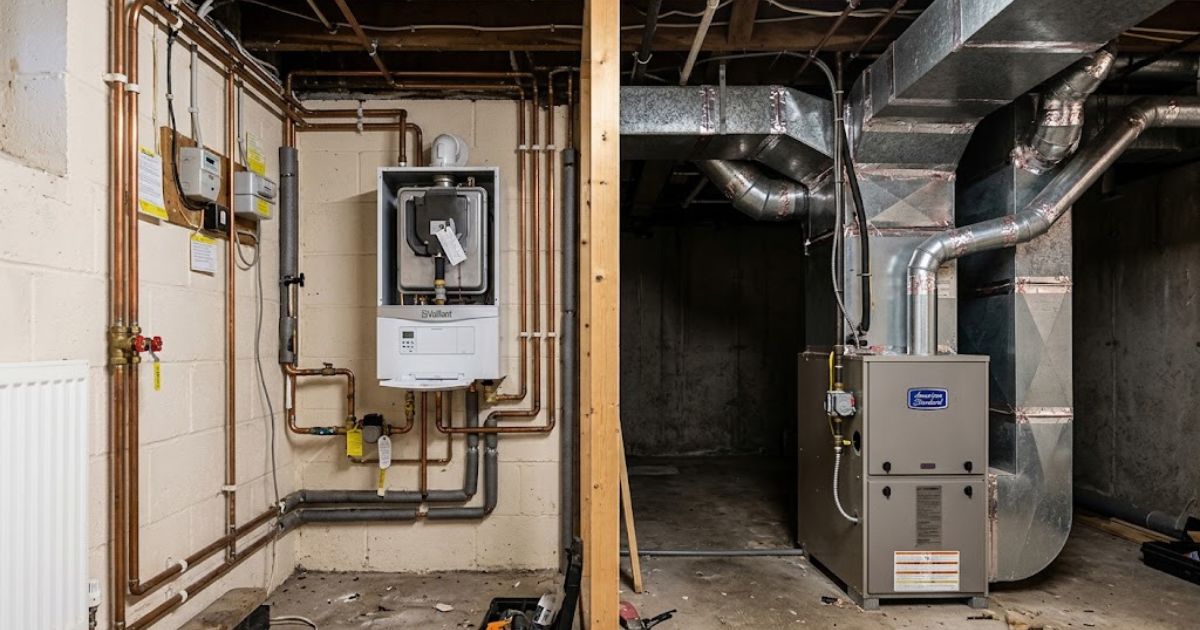
It sounds like a basic question, but plenty of homeowners genuinely don't know whether their home heats with a boiler or a furnace, especially if they didn't select or install the system themselves. The distinction matters more than it might seem, since the two systems fail differently, get maintained differently, and are repaired by addressing entirely different components.
What About The Thermostat And Vents?
A furnace-heated home typically has visible vent covers in floors, walls, or ceilings throughout the house, since forced air needs a distribution point in every room. A boiler-heated home instead has radiators, baseboard units, or, in newer installations, radiant tubing embedded in the floor itself, with no ductwork vents anywhere. If you're still unsure after checking the main equipment, walking through the house and noting which of these two patterns you see is a reliable secondary check. Even a single visible radiator or a single floor vent is usually enough to confirm which system you're actually dealing with.
The Quickest Way To Tell
Go to your utility closet, basement, or wherever your main heating equipment lives. If you see visible pipes carrying water or steam running to radiators, baseboard units, or a radiant floor system, you have a boiler. If you see a large metal box with ductwork, the rectangular metal channels, connected to it and distributing air throughout the house, you have a furnace. Boilers heat water or produce steam; furnaces heat air directly.
Why The Distinction Actually Matters
A boiler and a furnace share almost no common repair parts or failure points, since one is fundamentally a water-heating and circulation system while the other is a combustion and air-handling system. A technician diagnosing "no heat" needs to know which system they're dealing with before even opening an access panel, since the entire diagnostic process branches immediately based on the answer.
Not Sure Which System You Have?
We'll identify it and diagnose the actual issue.
Fuel Type Is A Separate Question From System Type
Both boilers and furnaces can run on natural gas, propane, oil, or electricity, so identifying your fuel type doesn't tell you which system category you have. A gas furnace and a gas boiler are both common, and the fuel source is really a separate specification layered on top of the more fundamental water-versus-air distinction covered above. Your utility bill or fuel delivery service can confirm fuel type if you're unsure, but that information alone won't tell you whether you have a boiler or a furnace.
What To Do If Your System Won't Turn On At All
If neither a boiler nor a furnace responds to the thermostat, check that the system's power switch, often a simple wall switch resembling a light switch near the unit, hasn't been accidentally turned off. For furnaces, a tripped safety shutoff from a clogged filter is a common and easily fixed cause. For boilers, a low-pressure reading on the gauge often explains a no-heat situation. If neither applies, that's the point to call for a professional diagnosis rather than continuing to troubleshoot blind.
Common Boiler Problems, In Plain Terms
Boilers commonly develop kettling, a banging or rumbling sound caused by mineral scale buildup inside the heat exchanger, especially in hard water areas like the Front Range. Circulator pump failure is another common issue, since that pump is responsible for moving heated water through the system, and its failure means water isn't circulating even if the boiler itself is heating properly. Pressure issues, either too high or too low, also affect boiler performance and are usually visible on a pressure gauge mounted on the unit itself.
Common Furnace Problems, In Plain Terms
Furnaces commonly develop issues with the ignition system, whether that's a pilot light on an older unit or an electronic ignition on a newer one, and either failure mode prevents the burner from lighting at all. A clogged air filter is an extremely common and easily preventable furnace issue, restricting airflow and forcing the system to work harder, sometimes triggering a safety shutoff. Blower motor failure, affecting the fan that pushes heated air through ductwork, is another frequent furnace-specific repair.
Age And System Type Together
Older homes in this region, particularly those built before forced-air ductwork became the residential standard, are more likely to have a boiler-based radiant system as original equipment. Homes built more recently, or those that have undergone a full mechanical system replacement, more commonly have furnaces paired with central air conditioning, since that combination shares ductwork efficiently between heating and cooling.
Can A Home Have Both?
Yes, and it's not unusual, especially in a home with a boiler-based radiant heating system plus separate central air conditioning, which requires ductwork that a pure boiler system doesn't otherwise need. In these setups, the boiler handles heating while a separate air handler manages cooling, and sometimes supplemental heating too, through the shared ductwork.
What This Means For Maintenance
Boiler maintenance focuses on pressure checks, circulator pump condition, and periodic flushing to manage scale buildup from hard water. Furnace maintenance focuses on filter replacement, ignition system checks, and blower motor condition. Scheduling the correct type of maintenance for your actual system, rather than a generic "heating system tune-up," ensures the specific components that actually fail in your system type get the attention they need.
Common Questions
Is a boiler more expensive to repair than a furnace?
It depends on the specific issue rather than the system type generally. Both have a range of possible repairs from minor to significant, and cost is driven by the actual failure, not which category of system it is.
Do boilers need a chimney or vent like furnaces do?
Most gas or oil boilers do need venting for combustion byproducts, similar to a furnace, though the specific vent configuration can differ based on the boiler's design and fuel type.
Why does my radiator make noise but my thermostat says the heat is off?
Residual heat in boiler system pipes can produce minor sounds even after the boiler cycles off, which is normal. Persistent banging while the system is actively running is more likely kettling from scale buildup.
Can I switch from a boiler system to a furnace, or vice versa?
Yes, but it's a significant renovation project involving new ductwork or new radiant piping depending on the direction of the switch, not a simple equipment swap.
Does a boiler heat a home faster or slower than a furnace?
Furnaces typically produce noticeable warmth faster since forced air heats the room's air directly, while boiler-based radiant heat warms more gradually but tends to feel more even and consistent once the space is up to temperature.
If you have a boiler showing any of these signs, our boiler repair page covers kettling, circulator pump issues, and pressure problems in more detail. If hard water is contributing to scale buildup in your heating system, our water softener installation and repair page covers that broader fix. Columbine Valley's older golf-course-era homes are a common setting for boiler-based radiant heat systems in our service area, given the age and style of construction throughout the town.